IBM DB2
Use the following procedure for monitoring the IBM DB2 database.
- Navigate to Database monitoring on the left pane.
- Select DB2 from the Select database drop-down list.
- Select a service from the Select service drop-down list.
- Select a database from the Select database drop-down list.
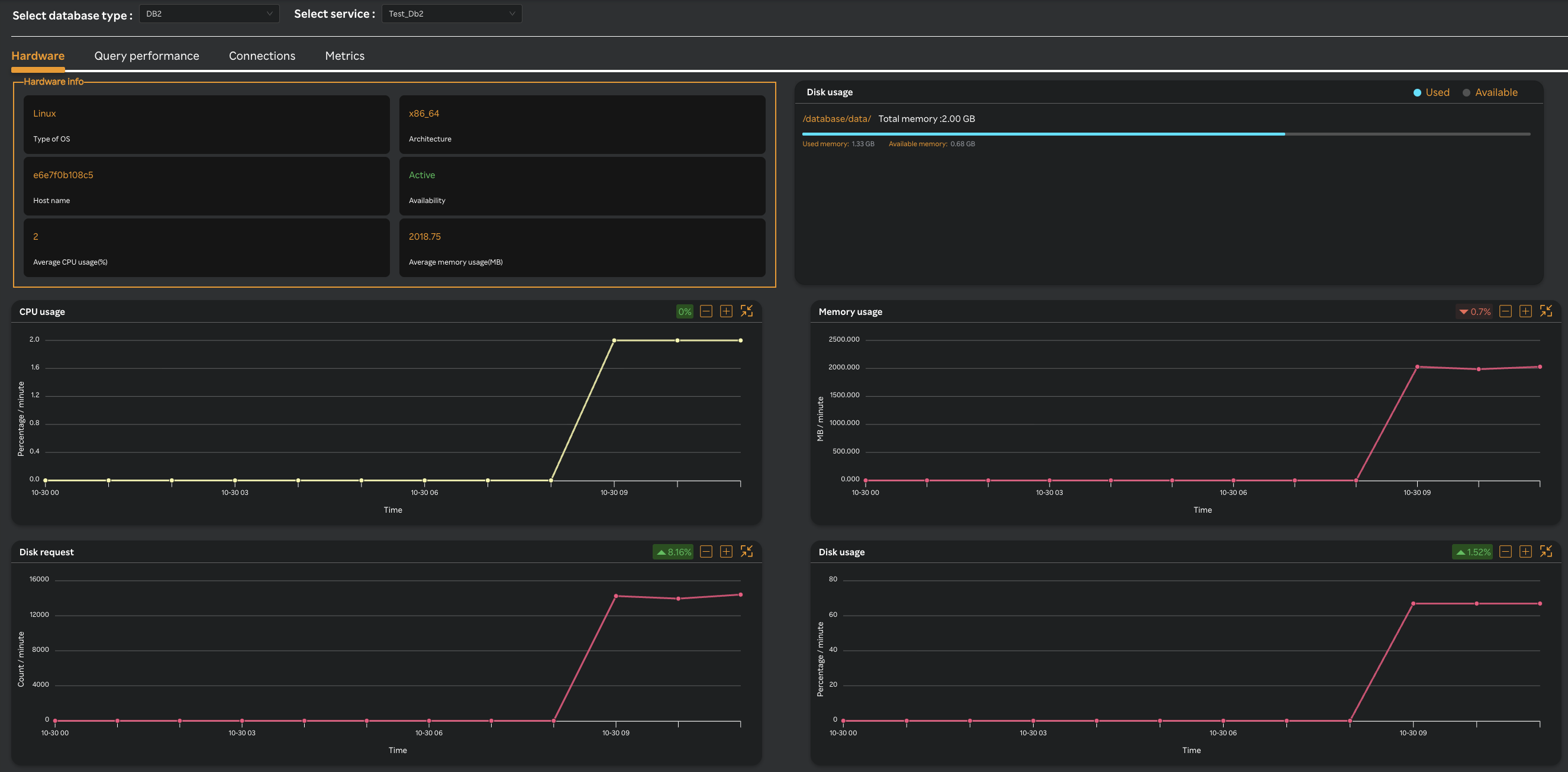
The following screen appears along with the various available tabs.
Hardware
The Hardware tab is selected by default. The following widgets are displayed.
| Widget Name | Description |
|---|---|
| Type of OS | Type of OS on which DB is running (Linux/Windows etc.) |
| Architecture | The OS architecture |
| Host name | Configured host name on which DB is present |
| Availability | Active/Inactive — the database availability |
| Average CPU usage (%) | Average CPU usage of the machine |
| Average memory usage (MB) | Average memory usage of the machine |
| Disk usage | Disk space utilization |
| CPU usage | CPU utilization of the host |
| Disk request | Disk I/O request rate in DB2 Database |
| Memory usage | Memory utilization |
Query Performance
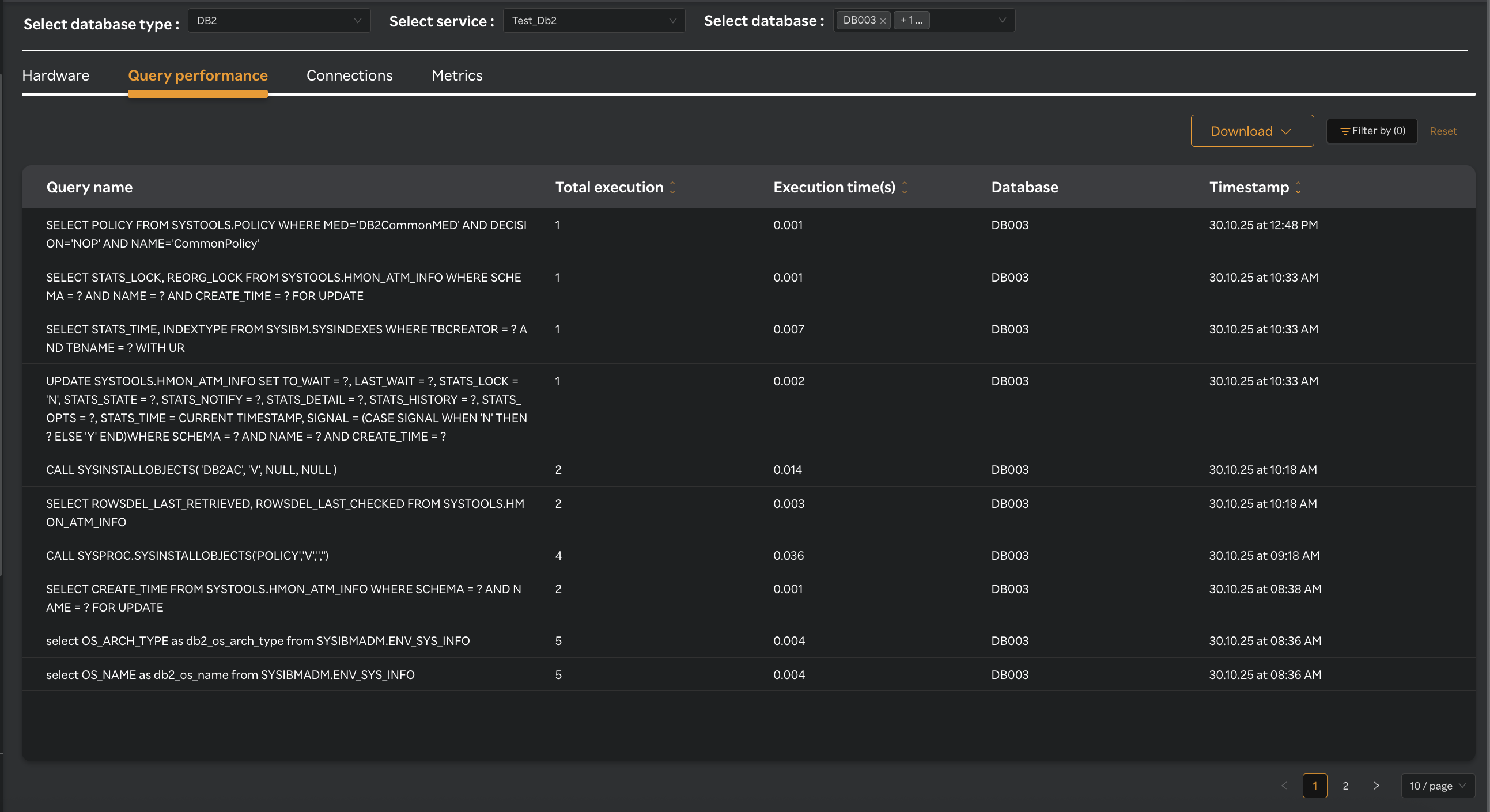
Clicking the Query Performance tab and selecting the threshold from the Query threshold drop-down list displays the following screen.
note
You can download the Query Performance table in PDF format by clicking the  icon. Only the top 100 entries are downloaded if there are more than 100 entries for downloading.
Connections
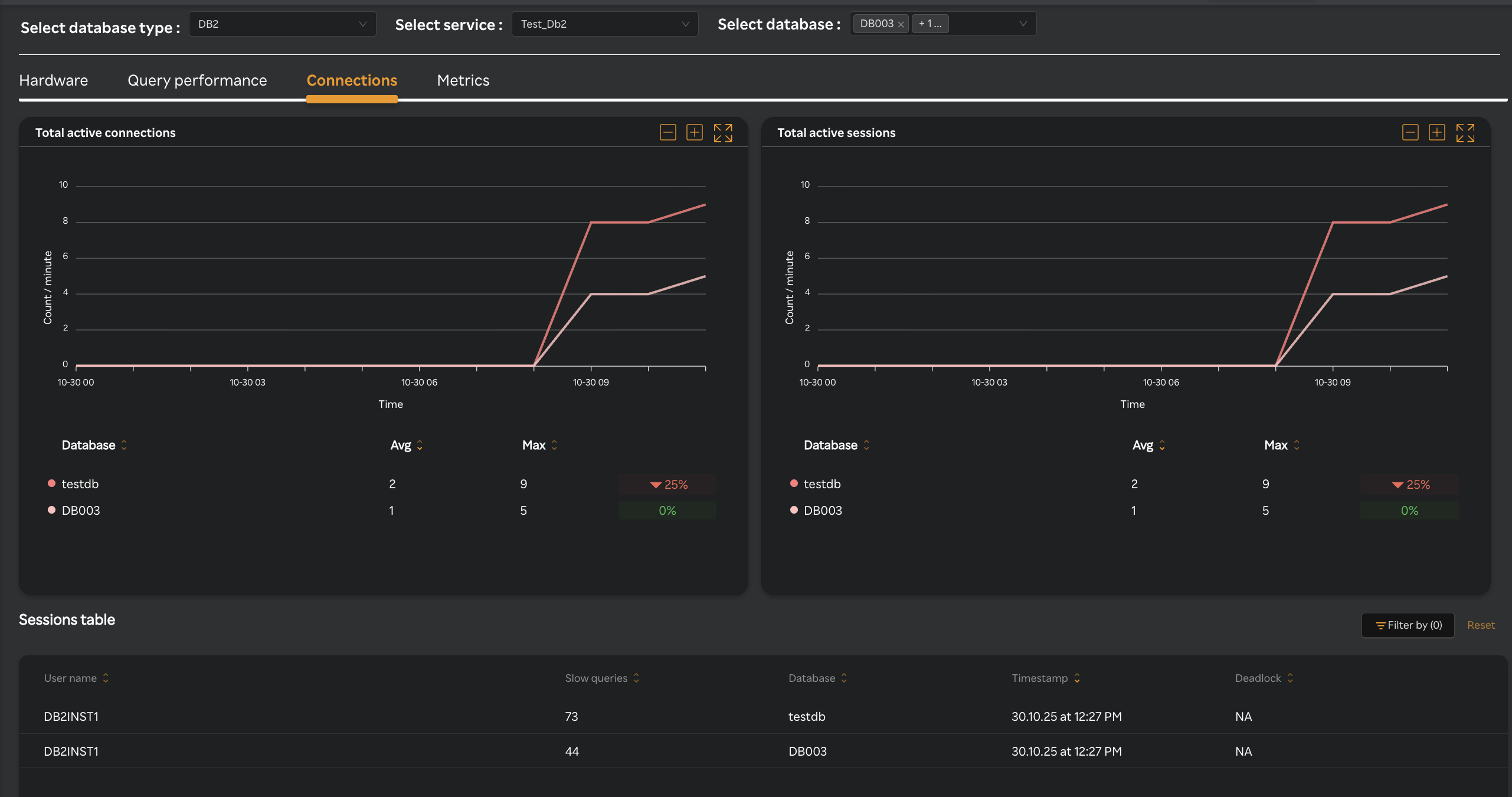
Clicking the Connections tab displays the following widgets as in the following screen.
| Widget Name | Description |
|---|---|
| Total active connections | Number of currently active connections |
| Total active sessions | Total number of active DB sessions |
| Sessions table | Table displaying details of DB sessions |
Metrics
Clicking the Metrics tab displays the following widgets.
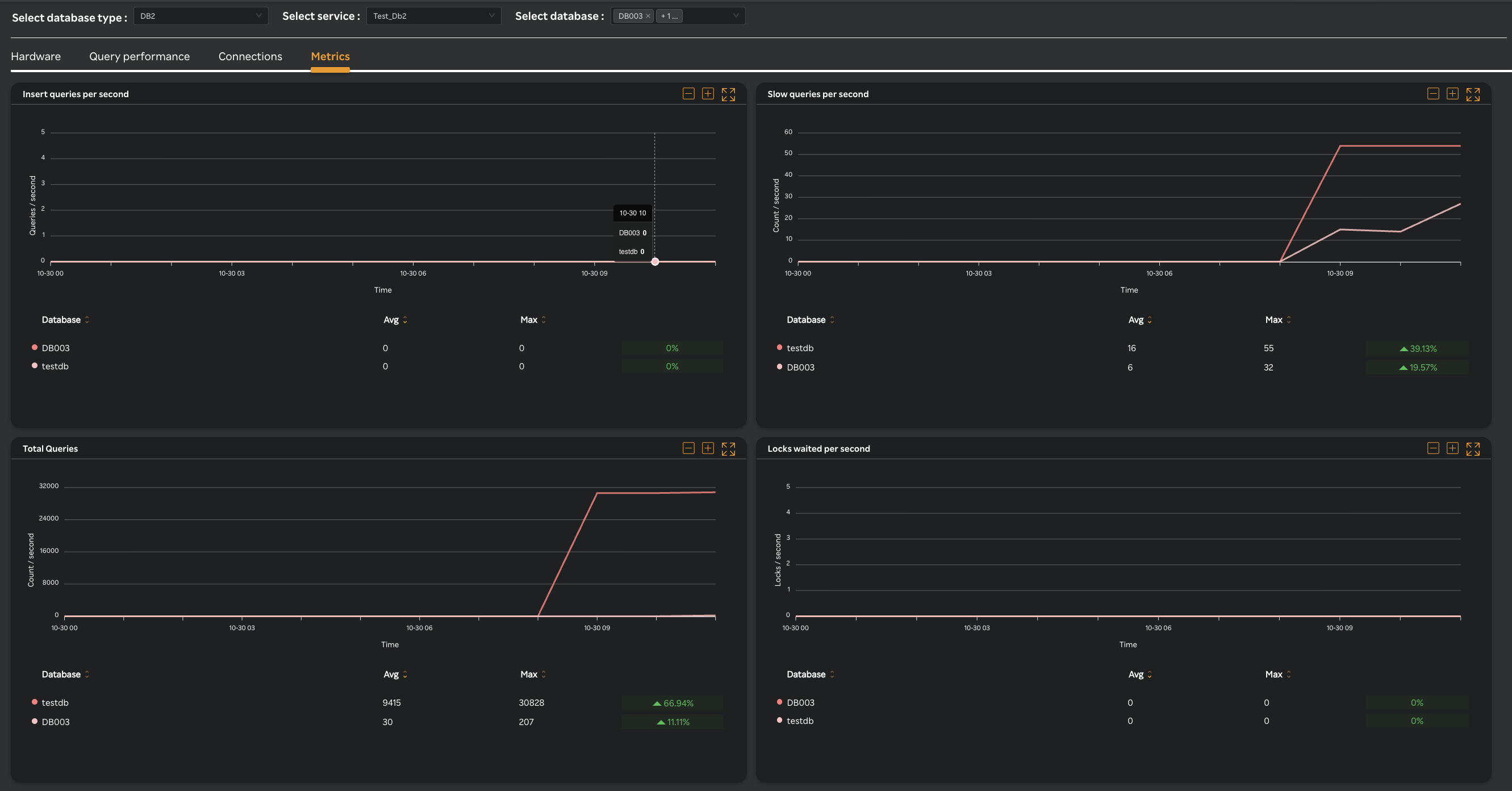
| Widget Name | Description |
|---|---|
| Insert queries per second | Number of insert queries executed per second |
| Slow queries per second | Number of slow queries executed per second |
| Total queries | Total number of queries executed |
| Locks waited per second | Number of lock waits per second |
| Max connection per second | Maximum number of connections per second |
| Total buffer pool reads | Total number of reads from buffer pool |
| Buffer pool cache hit ratio | Percentage of reads served from buffer pool (cache hits) |
| Transactions per second | Number of transactions executed per second |
| Buffer pool size per DB | Buffer pool size allocated per database |
| System wait time (ms) | Average wait time of system resources |
| Deadlocks per second | Number of deadlocks detected per second |
| Total open tables | Total number of open tables in the database |
Multi-column Filter
Query performance
- Multi-column filter can be applied on numeric columns within the Query performance Table to refine the displayed data based on specific conditions.
- When the user clicks on the “Filter by” option, user can apply filter below numeric columns
| Column Name | Description |
|---|---|
| Total execution | Total number of query executions recorded. |
| Maximum execution time (s) | The longest query execution time recorded in seconds. |
| Maximum execution timestamp | Date and time when the longest-running query was recorded. |
- Each filter condition is applied using the below operators and value ( user input based on the unit)
| Operator |
|---|
| Greater than |
| Less than |
| Equals |
| Greater than or equals |
| Less than or equals |
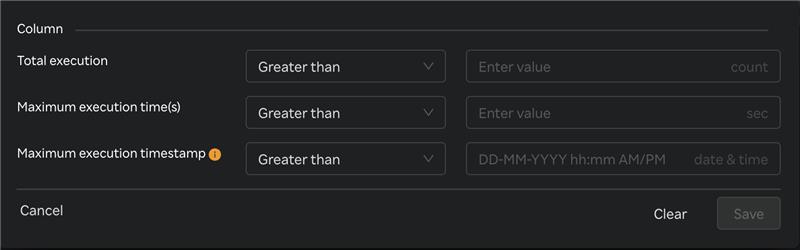
- Once filters & conditions are applied save button is enabled & click "Save" to apply the filter.
- Once filters & conditions are applied it displays no. of filters are applied.
note
- Filters are applied using AND logic — all specified conditions must be met for a record to be displayed.
- Only numeric columns support filtering; non-numeric fields (e.g., text or categorical values) are excluded from the filter options.
- When the Maximum Execution Timestamp (s) filter is applied, the system reviews each query in the table. If a query was executed within the time frame selected in the top-right corner, it displays that query’s maximum execution timestamp and maximum execution time.
- If no records match the selected filters, the table will display a message such as “No data".
- The multi-column filter state persists until the user clears filters by clicking on "Clear" button when Filter by button is clicked.
- A "Reset" button is available to clear all applied filters and restore the table to its original, unfiltered state. This button is enabled only when one or more filters are currently applied.
